ChatGPT vs OpenAI API: What’s the Difference?
ChatGPT vs OpenAI API: What’s the Difference?
When people hear ChatGPT and OpenAI API, they often assume they are the same thing. In reality, they are two different ways of accessing OpenAI’s language models.
ChatGPT: A Complete User Experience
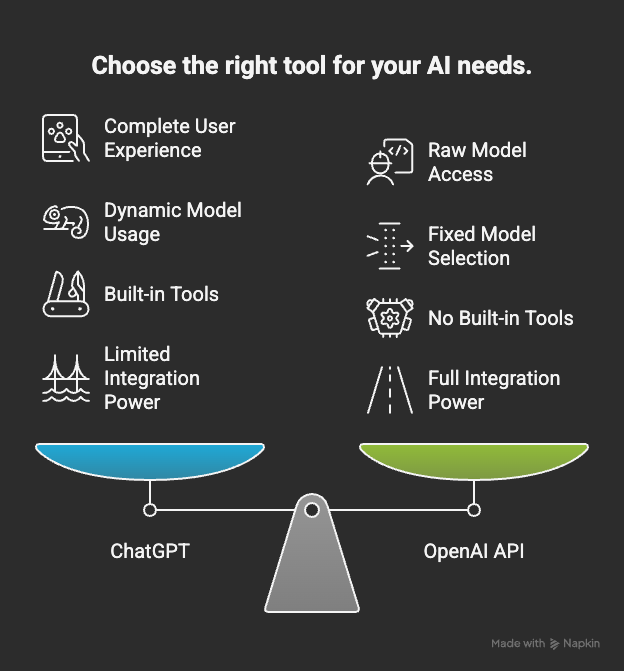
ChatGPT is the ready-to-use product that OpenAI provides to end users. It’s what you interact with on the web app or mobile app. You can type questions, upload files, or even use images and voice in some versions. OpenAI has built a full experience around the underlying model:
- Interface: clean chat UI with conversation history.
- Hardware Control: ChatGPT has its own hardware infrastructure, enabling them to regulate pricing and offer cost-effective analysis compared to developing a custom app using their API.
- Tools: some versions of ChatGPT include browsing, code execution (data analysis), or third-party plugins.
- Memory: newer versions can “remember” past interactions over sessions.
- Dynamic model usage: ChatGPT can intelligently switch between different underlying models depending on the task. For example, a lightweight model might handle quick conversation, while a more advanced one (like GPT-4) may be called for complex reasoning or code execution. This blending makes responses feel seamless, but it also means the exact model used can vary during a session.
- Defaults: temperature, formatting, and guardrails are tuned for a helpful, safe conversation.
When you upload a CSV or ask ChatGPT to do some analysis, the model is running inside OpenAI’s environment with pre-installed tools. You don’t see the complexity — it just works.
OpenAI API: Direct Access to the Model
The OpenAI API, on the other hand, gives you the raw model without the additional tools or interface. Think of it as the engine under the hood. Through the API, developers can send structured prompts and receive outputs from the model in their own apps.
Key differences:
- No interface: You build the UI or workflow around the API.
- No access to websearch: You have to use third party tools integrate the web search. Some model have started supporting the websearch natively.
- No built-in tools: The model does not have browsing, code execution, or data upload unless you implement them.
- Full control: You decide the system prompt, memory handling, and how responses are presented.
- Integration power: You can connect the model to your own data sources, APIs, or business logic.
- Pricing model: You pay per token (input and output text), not per subscription.
- Fixed model selection: In the API, you explicitly choose which model to call (
gpt-4.1,gpt-4o-mini, etc.), and that’s the one that processes your request. This makes it more predictable than ChatGPT, but also means you must balance cost and performance yourself.
For example, if you want your AI to analyze a CSV, the API itself won’t magically parse the file. You must handle the file upload, extract the data (e.g., with Python and pandas), and then pass either the raw text or structured summaries into the model. The model provides intelligence, but the surrounding pipeline is your responsibility.
Why the Difference Matters
If your goal is simply to use AI for yourself — brainstorming, writing, quick data analysis — ChatGPT is the right choice. It’s polished, easy, and requires no setup.
If your goal is to embed AI into your own product or workflow, then the API is the way to go. It gives you flexibility to:
- Connect the model with private data (databases, APIs).
- Add your own tools (custom code execution, search).
- Control the prompts and outputs for consistent results.
- Scale to multiple users inside your business.
Quick Analogy
Think of ChatGPT as Tesla’s finished car — ready to drive, with autopilot and entertainment system included. The OpenAI API is the Tesla engine — powerful, but you have to build your own car around it.
In short: ChatGPT is a complete experience with tools and dynamic model switching. The OpenAI API gives you the raw model you explicitly choose — flexible, predictable, and ready to integrate into your own systems.